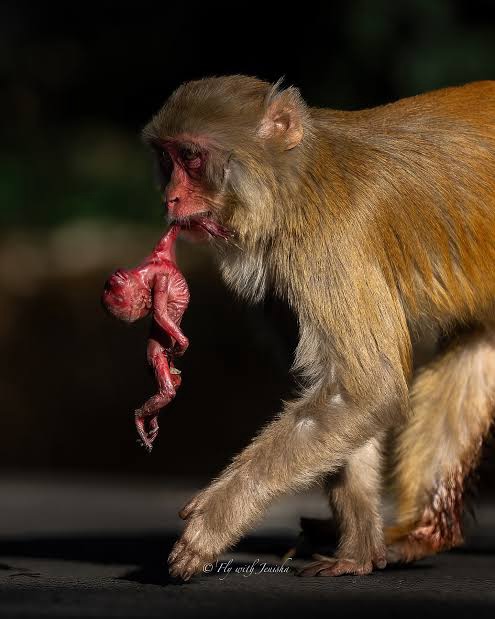
In the dense forests of South Asia, a scene unfolds that captures the raw emotion of life and loss in the animal world — a mother monkey holding her lifeless baby, refusing to let go. The tragic image has moved people around the world, not only for its sadness but for what it reveals about the deep emotional bonds that animals share — bonds that are, in many ways, not so different from our own.
Witnesses describe how the mother sat silently, cradling the tiny body against her chest, gently grooming it as if trying to wake her baby from a deep sleep. Hours passed, and she refused to move, even when other monkeys tried to approach or when the rest of her troop continued their daily search for food. Her every gesture was filled with grief and disbelief — emotions we often assume are uniquely human.
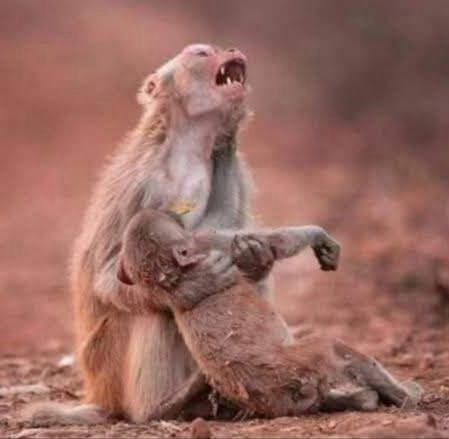
Animal behaviorists have long documented similar scenes among primates. Studies show that monkeys, chimpanzees, and other intelligent mammals often exhibit mourning behaviors when faced with the death of a loved one. Mothers, in particular, are known to carry their dead infants for hours, days, or even weeks. Experts suggest that these actions stem from both instinct and emotion — an inability to immediately understand that death is final, combined with the powerful maternal bond that drives them to protect and comfort their young at all costs.
In this particular case, the mother’s refusal to leave her baby behind became a painful symbol of maternal devotion. Park rangers and researchers observed her from a distance, noting how she kept the baby close even as its tiny body grew cold and stiff. Eventually, when hunger and exhaustion took over, she began to move again — still carrying her baby as she climbed trees and crossed open ground.
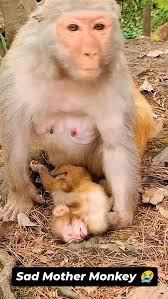
For humans who witnessed the event, the scene was almost unbearable. Some cried openly, saying they had never seen such emotion in an animal before. “It was like watching a mother lose her world,” one observer said quietly. “She just couldn’t accept that her baby was gone.”
This heartbreaking moment serves as a powerful reminder that love, loss, and grief are not limited to humans. Scientists have found that many animals — from elephants to dolphins to birds — experience mourning behaviors. Elephants, for example, have been observed standing silently over the bodies of their dead, touching them gently with their trunks. Dolphins will circle a dead calf, nudging it repeatedly toward the surface as if urging it to breathe again.
The mother monkey’s sorrow also raises profound ethical and philosophical questions about how we see animals. For too long, humans have underestimated the emotional intelligence of other species, assuming that their lives are governed solely by instinct. Yet moments like this challenge that assumption. They reveal that animals, too, feel the weight of love, connection, and loss — perhaps not in words, but through actions that speak just as clearly.
As the sun set that evening, the mother finally laid her baby down beneath a tree. She sat beside it for a long time, staring at the still form before her. Then, slowly, she turned and disappeared into the forest. It was as if she understood, at last, that her little one was gone — though the pain of letting go must have been unbearable.
The story of the grieving monkey reminds us that the emotions binding mother to child transcend species. Whether human or animal, a mother’s love is one of nature’s most powerful forces — capable of tenderness, sacrifice, and heartbreak. In her silent vigil, that mother monkey spoke for every mother who has ever lost a child: love does not end, even when life does.