Preliminary Investigation Finds Engine Suddenly Spooled Up After Touchdown in Hong Kong Cargo Plane Crash
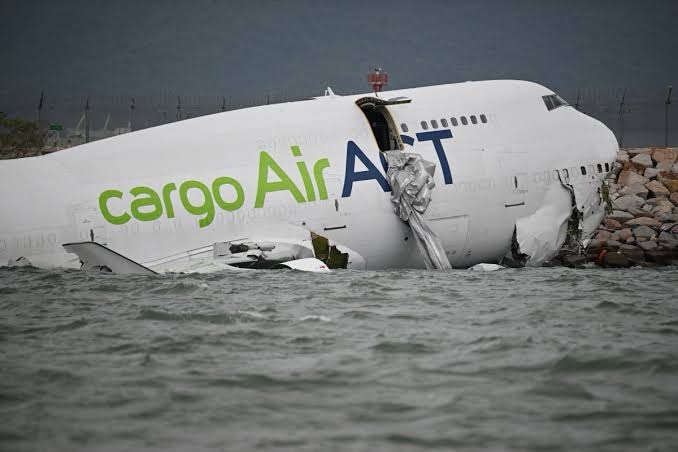
A preliminary investigation into the cargo plane crash at Hong Kong International Airport on October 20, 2025 has uncovered a startling finding: one of the aircraft’s engines accelerated after the plane touched down – a highly unusual occurrence that may have played a central role in the runway accident.
The aircraft involved was a Boeing 747 freighter, operated by Turkey-based ACT Airlines on behalf of Emirates, arriving from Dubai. According to the initial report released by Hong Kong’s Air Accident Investigation Authority (AAIA), conditions during the flight were normal, and there was no indication of distress prior to landing.
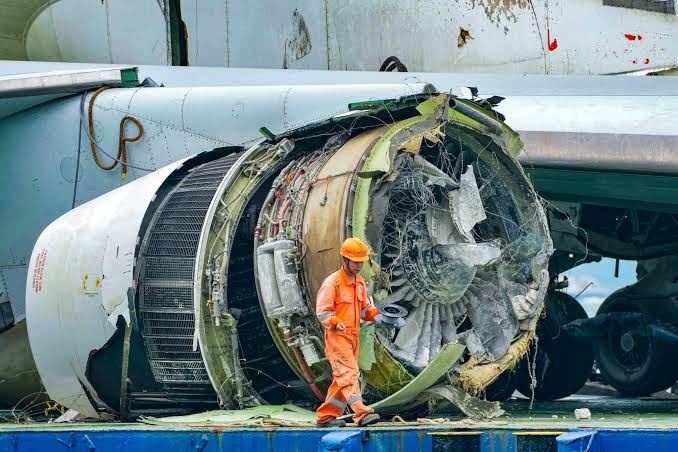
However, shortly after touchdown, the automatic braking system disengaged. In response, the captain took manual control of braking. Almost at the same time, the number 4 engine – located on the far right side of the plane – suddenly spooled up, accelerating sharply from 90% thrust to as much as 106–107% over a span of 12 seconds.
This surge occurred while the reverse thrust levers on the other three engines were engaged; their thrust levers were closed, and the crew had selected reverse on engines 1, 2, and 3. Disturbingly, by the time the number 4 engine had spooled up, the reverse levers on that engine appear to have been stowed, which may have contributed to a loss of deceleration.
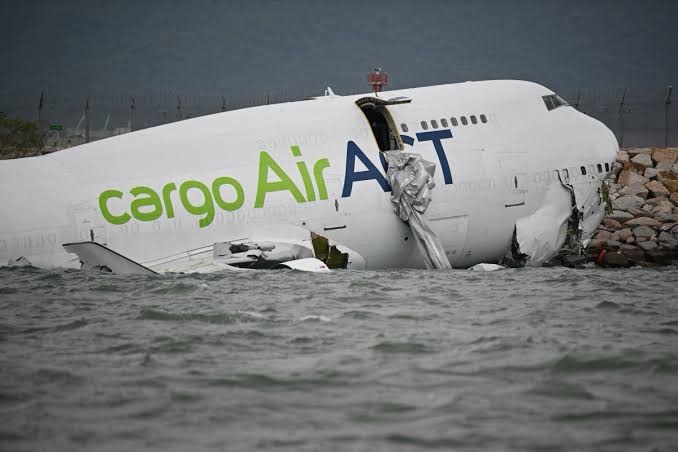
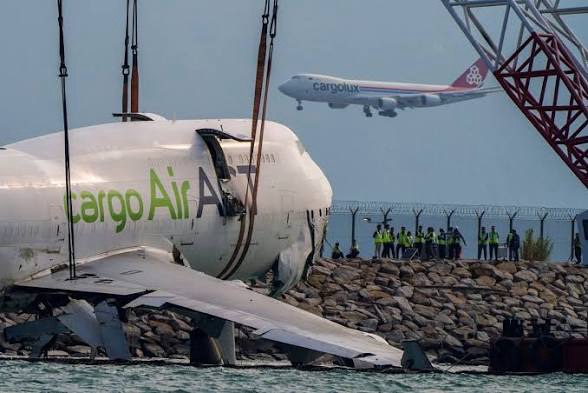
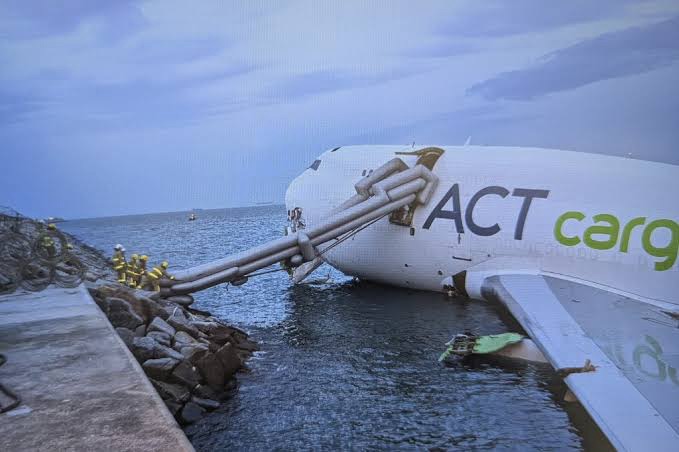
The airplane then veered off the runway to the left and collided with a stationary security patrol vehicle stationed just outside the runway perimeter. The impact sent the car plunging into the sea. Tragically, the two airport ground security personnel inside the vehicle were killed. All four crew members aboard the aircraft survived the incident unharmed.
Following the accident, investigators examined the cockpit. They discovered that while engines 1, 2, and 3 had their thrust levers closed with full reverse selected, the thrust lever for engine 4 was inexplicably found in the full forward thrust position. Its reverse thrust lever was also fully forward – a contradictory configuration that may explain how the engine surged rather than helped slow the aircraft.
The preliminary report stops short of assigning a definitive cause, but it identifies several key issues that will be the focus of further investigation. Among them: whether there was a mechanical or system failure that caused the number 4 thrust lever to move unexpectedly, possible problems with engine systems, the condition and maintenance history of the engines, and human or operational factors.
Notably, the investigation is being supported by international experts. Specialists from Turkey’s Transport Safety Investigation Center, the U.S. National Transportation Safety Board (NTSB), and Boeing are all contributing to the analysis. The AAIA aims to produce a full and comprehensive report within the next year.
Industry experts have described the post-touchdown thrust surge as “highly unusual.” Steven Dominique Cheung, chairman of the Hong Kong Professional Airline Pilots Association, warned that with only the right-side engine at full power while the others were in reverse, maintaining control of the aircraft would be extremely difficult.
Another striking detail: the report notes that the number 4 thrust reverser was inoperative. Under the aircraft’s maintenance protocol, this was legally permissible, but the absence of a functioning reverser likely made the consequences of the thrust surge much more severe.
Looking ahead, investigators plan to conduct a detailed technical review. They will examine flight-data recorder information, maintenance logs, cockpit voice recordings, and the design and operation of the thrust lever system. Human-factors experts will also analyze crew actions: why the number 4 lever ended up where it did, how the crew responded to the automatic brake disengagement, and whether their reactions were consistent with training and standard procedures.
The accident is already being described as one of the deadliest at Hong Kong International Airport in over 25 years. Its peculiarity – particularly the idea of an engine accelerating after landing – has shocked both aviation professionals and safety regulators.
As the probe continues, the final report will seek to draw lessons that may prevent a recurrence. If mechanical or system failures are found to be at fault, regulators may require design changes, additional inspections, or new protocols for reverser maintenance. If human error emerges as a contributing factor, training procedures and crew performance standards may be reexamined.
Whatever the outcome, investigators say they will draw on global aviation expertise to ensure a thorough and transparent process.